Industry Insights
Ranked 54th, but Actually 3rd?
What aerial duel win rate misses. The BEPRO Data Science team analyzed 33,163 K League 1 aerial duels to develop a height-adjusted Elo rating methodology, now integrated into PEI.

How height-adjusted Elo ratings reveal the true aerial duel masters
A player ranked 54th in aerial duel win rate jumps to 3rd when opponent difficulty and height are factored in.
This is a finding from an aerial duel study analyzing 33,163 aerial duels in K League 1. The reversal tells us one thing: "Win rate tells you how often a player won, but not who they won against."
From goal kick second balls to in-box cross clearances and set-piece contests, moments where a single header directly impacts possession, pressing, and goal-scoring risk appear consistently throughout a match. How to properly evaluate that ability is a critical question.
The Pitfall of Win Rate
The most common way to measure aerial duel ability has been win rate.
Aerial Duel Win Rate = Wins / Attempts
It is intuitive and simple to calculate. But can we trust this number at face value?
First, it does not account for opponent difficulty. A 60% win rate against dominant center-backs every time is very different from 60% against relatively weaker matchups.
Second, it ignores the structural variable of height. Aerial duels are realistically influenced heavily by height. Teams factor height into matchup planning as well.
When relying on win rate alone, skill, context, and physical attributes all get blended together. To find the players who are truly strong in the air, we need a metric that reflects context.
Enter Elo Rating
To address the weaknesses of win rate and achieve more accurate evaluation, the BEPRO Data Science team proposes interpreting aerial duels as 1v1 matchups between two players.
The approach applies Elo rating, a system familiar from chess and Go.
The core principle of Elo is simple.
Beat a stronger opponent, and your score rises more.
Lose to a weaker opponent, and your score drops more.
In other words, it is not simply "how often did you win" but rather "who did you win against" that accumulates into the score. A far more meaningful question for scouting and opposition analysis.
This research was published as an SCI journal paper in the International Journal of Performance Analysis in Sport. It analyzed 33,163 aerial duels across 684 matches in K League 1 from the 2021-2023 seasons. (Kim & Kim, 2024, DOI: 10.1080/24748668.2024.2420458)
The Key: Height-Adjusted Initial Elo for Faster Stabilization
Traditional Elo systems start all players at the same initial value (e.g., 1500), with ability values gradually determined as data accumulates.
However, aerial duels come with a well-known premise: taller players have an inherent advantage.
The BEPRO research team set initial values as follows.
Calculate Elo without height adjustment first.
Apply linear regression between player height and calculated Elo.
Use the regression predictions as height-adjusted initial Elo values.
This does not mean "taller players are rated higher." It is a method to acknowledge the structural advantage of height and then compare skill more fairly on top of it.
For example, Dave Bulthuis (192cm) starts with an initial Elo of 1561.76, while Sunmin Kim (167cm) starts at 1426.92. From there, Elo updates continuously based on actual aerial duel results.
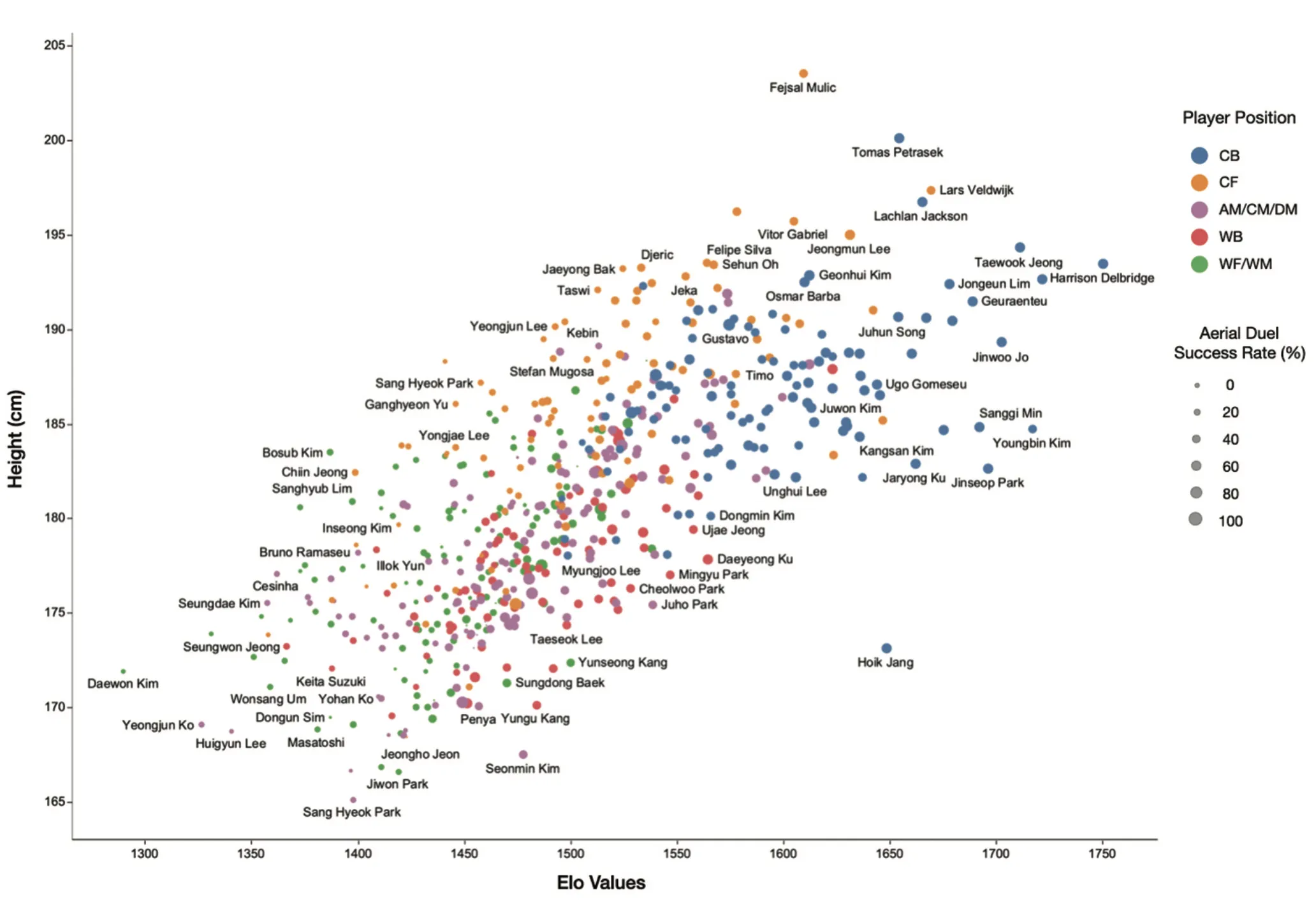
In terms of model performance, the height-adjusted Elo (K=10) showed higher accuracy (0.626) and AUROC (0.649) compared to the non-adjusted model.
Elo Reveals a Different Picture

The most interesting result from the aerial duel analysis is the ranking reversal.
Elo Rank | Player | Elo Score | Win Rate | Win Rate Rank |
|---|---|---|---|---|
1st | Harrison Delbridge | 1750.49 | 71.8% | 3rd |
2nd | Dave Bulthuis | 1721.61 | 66.8% | 21st |
3rd | Youngbin Kim | 1717.30 | 62.0% | 54th |
4th | Taewook Jeong | 1711.27 | 76.3% | 1st |
Delbridge is a genuinely strong player by both win rate and Elo.
More notable are Bulthuis and Youngbin Kim. They rank only 21st and 54th by win rate, but climb to 2nd and 3rd in Elo.
These players did not simply win a lot. They can be interpreted as having "consistently maintained competitiveness even against tough opponents."
Conversely, Taewook Jeong, ranked 1st in win rate, drops to 4th in Elo. Even with a high win rate, factoring in matchup difficulty changes the ranking.
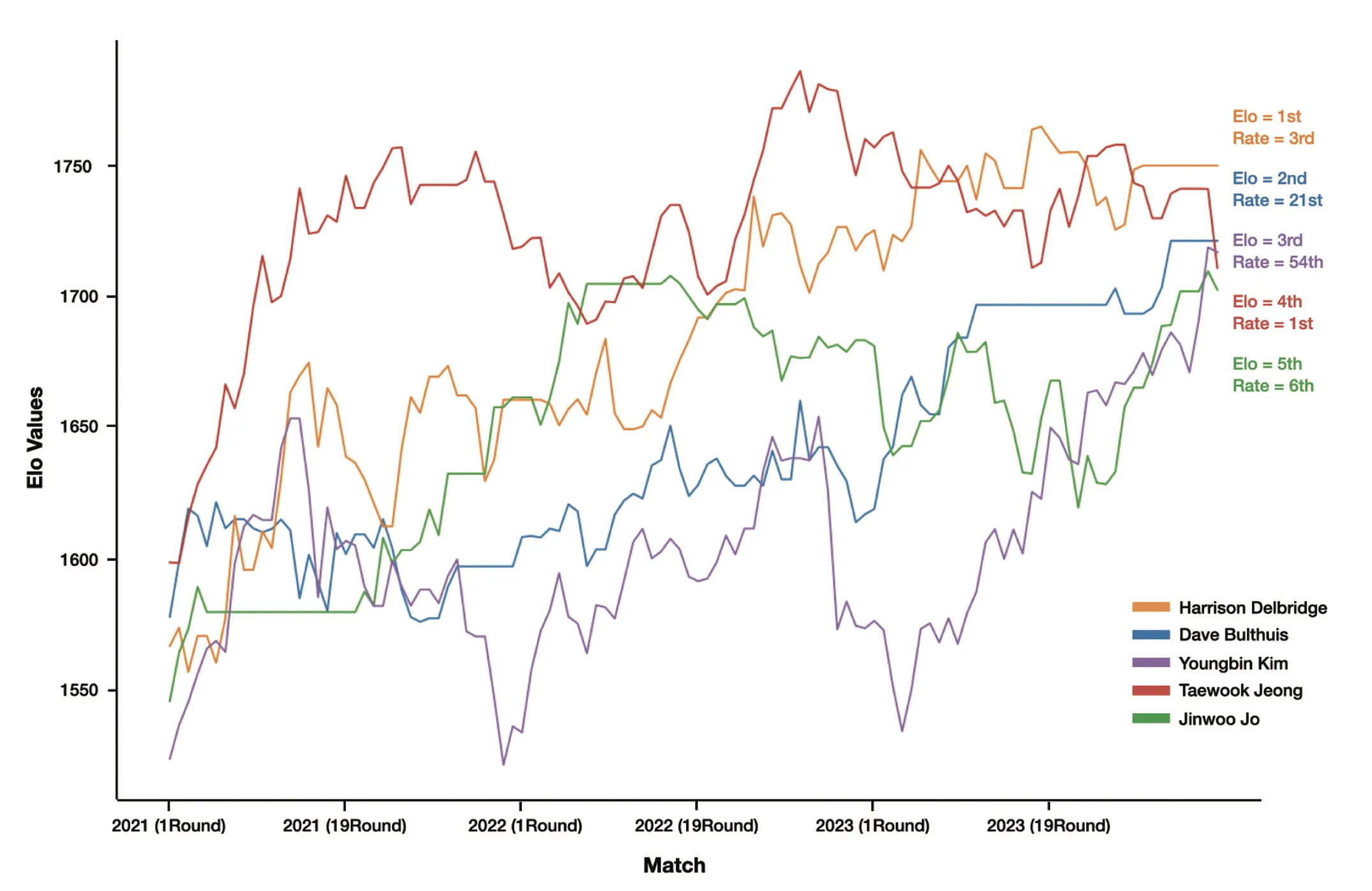
In summary:
Win rate measures "how often did you win."
Elo measures "who did you win against (difficulty included)."
From Research to Product: Integrated into PEI

This research does not stop at academic achievement.
BEPRO has integrated this height-adjusted Elo rating metric into PEI (Player Evaluation Index), applying it in an actual product.
What this metric means in PEI is practical.
For scouting and recruitment, it enables faster discovery of players who do not appear on win rate leaderboards but consistently handle tough matchups. It is an effective tool for finding players with hidden value.
For opposition analysis and tactics, identifying true aerial strengths and weaknesses allows more evidence-based decisions in set-piece matchup design, cross target zone selection, and personnel deployment.
The BEPRO Data Science team continues the cycle of researching advanced metrics that reflect context beyond basic statistics and applying them to actual products. This aerial duel analysis is one example of that pipeline.
To learn more about BEPRO products, leave a message on our Contact Us page.
Research Paper. Kim, J. & Kim, S. (2024). Evaluating aerial duel ability of football players using height-adjusted Elo rating model. International Journal of Performance Analysis in Sport. https://doi.org/10.1080/24748668.2024.2420458